The Content API for Shopping Shuts Down August 18: How to Know in 5 Minutes If It's Your Problem
A store owner recently posted a simple question in the Google Ads Community. He had received an email from Google about moving from the Content API to the new Merchant API, he uses Merchant Center Next, and he had no idea whether he needed to do anything. That question is not an isolated one. Most articles about this deadline are written for developers or for agencies, not for the store owner who just got an email and wants to know one thing: does this affect me?
The short answer: probably not. But "probably" is not the same as "certain," and certain costs you five minutes.
Key insights
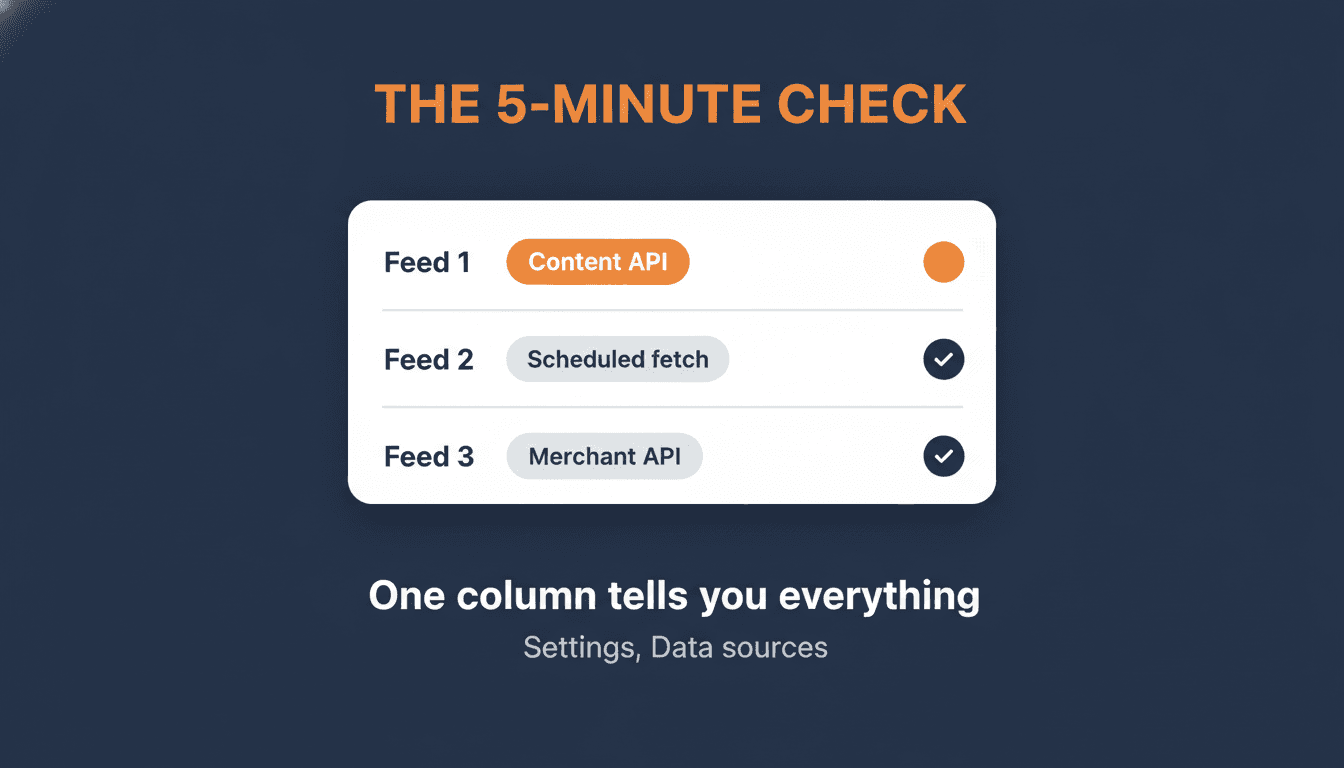
- One column in Merchant Center Settings tells you everything: Data sources shows whether each source uses the Content API or something else.
- Most stores are not affected. Scheduled fetch, manual file uploads, and Google Sheets feeds keep working exactly as they do today.
- The real risk is invisible: a custom API integration or an old feed tool that was never migrated can fail with no error code, no disapproval, and no warning.
- There is an official extension form (to October 15 or December 31, 2026), but it is not automatic. Apply if you are not going to make the deadline.
What actually happens on August 18, 2026
Google is replacing the Content API for Shopping, the programming interface tools and scripts have used for over a decade to push product data into Merchant Center, with the new Merchant API. On August 18, 2026, the old API shuts off for good. Not gradually. There is no countdown of warnings in your account that slowly get stricter. On that date, code that talks to the old API simply stops working.
This was announced back on August 18, 2025, so there has been a full year of transition time. If you have not touched this yet, that is not bad luck, there was simply never a reason to look at it before. That is exactly why this deadline catches so many store owners off guard: it happens in a layer you never normally see, between your product data and Merchant Center.
The five-minute test
This is the only thing that actually matters, and it takes you five minutes.
Log into Merchant Center and go to "Settings" then "Data sources." A column next to every source you see there shows which method that source uses to deliver data. If it says Content API, you (or a tool acting on your behalf) are using the old route and should keep reading. If it says Merchant API, a file upload, a scheduled fetch, or a Google Sheets connection, you do not need to do anything.
If you are not sure how your feed gets there in the first place, the question to ask your developer or your feed tool is simple: are we using the Content API, or have we already moved to the Merchant API? One sentence, and you have your answer.
Who needs to act, and who does not
This is where most coverage of this deadline gets it wrong. It buries the reassurance under alarming language, when the reality for most stores is simple.
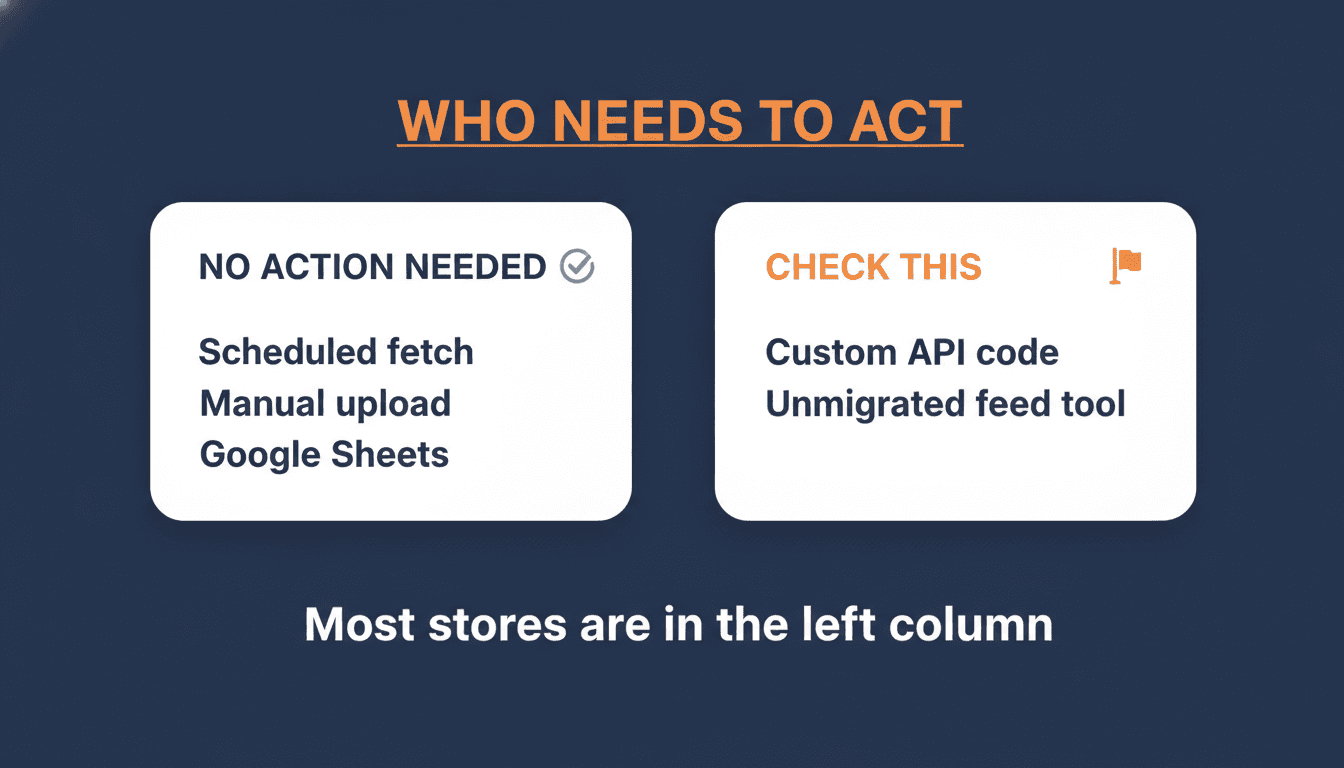
Do you deliver your feed to Merchant Center through a scheduled fetch, a manual XML or CSV upload, or a Google Sheets connection? Then you are not affected. That is how the majority of small to mid-sized stores submit their feed today, and it keeps working exactly as it does now.
Who does need to act: stores with a custom-built integration that talks to the Content API directly, or a feed tool that still runs on the old API internally and was never migrated. That second group is the real risk, not because it is common, but because it is invisible until it breaks.
What goes wrong if you miss it
A broken feed pipeline rarely gives you a clear signal. Three ways that plays out in practice, known scenarios from real migration write-ups, not something Google itself announces this way:
Calls to the API can authenticate just fine and return an empty list, with no error code at all. Nothing in a monitoring script trips on that.
Anyone migrating by hand without correctly converting the data structure (prices moving to a different format, status values changing from spaces to underscores) risks mispricing an entire catalogue.
And products tied to a specific feed configuration can end up in a feed that no active campaign targets. No disapproval in Merchant Center, no error in your logs. The product just quietly disappears from Shopping and Performance Max, and you notice only once revenue drops.
That last one is why a feed problem is always more expensive than an ad problem. A bad bid setting shows up in your results. A silent feed break shows up in your revenue, weeks later.
The nuance almost everyone is missing: there is an extension form
Since July 20, 2026, eight days before this was written, Google has had an official extension request form open for anyone who will not make the deadline. You can choose between an extension to October 15 or December 31, 2026.
Important: this is not an automatic extension. Google is explicit about this: if you do not apply, your application is not approved, or you go past your approved date, you still experience service degradation. This is an escape hatch for people already migrating who need more time, not a free pass to ignore the deadline.
Most articles about this shutdown do not mention this form at all, simply because it is newer than the articles themselves. If your developer or feed tool tells you migrating before August 18 is not realistic, this is the form to ask about.
Why this is a feed problem, not an ad setting
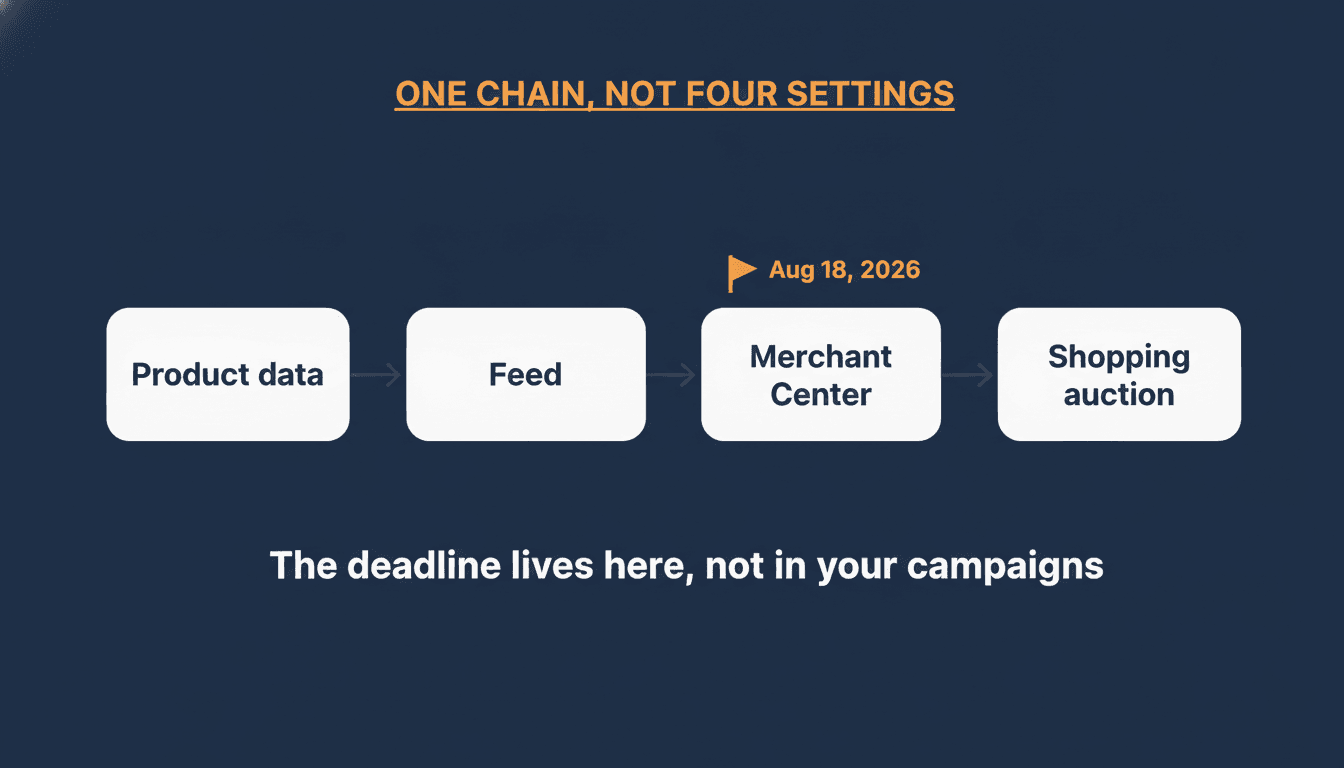
This entire story plays out in the layer between your product data and Merchant Center, not in your Google Ads campaigns. Your bid strategy, your audiences, your ad copy, none of that changes because of this deadline. What changes is the road your product information travels to get to Google in the first place.
That distinction is exactly why feed problems get overlooked so often. Everyone looks at the campaign when something breaks, while the cause sits one layer earlier. Anyone who knows the whole chain, from product data to feed to Merchant Center to the auction, sees a deadline like this for what it is immediately: a checkpoint in the pipeline, not in the ads. It is the same reason I never look at feeds and campaigns as separate worlds when I review an account, and it is worth checking your setup against the complete guide to Google Ads for ecommerce while you are in there, since a deadline like this is exactly the kind of gap a wider feed health check catches. If your feed ever throws a "feed could not be fetched" error, this is one of the root causes worth ruling out first.
What to do now
Check today, not next week, which data source you use in Merchant Center. It costs five minutes and gives you certainty instead of a vague feeling that something might be wrong. If you use the Content API and are not confident you will migrate in time, request the extension form yourself or have your developer do it.
Want to know your entire Google Shopping account is healthy, not just this one setting? That is exactly what an account review covers.
Frequently asked questions
How do I know if I use the Content API for Shopping?
Open Merchant Center and go to "Settings" then "Data sources." The column next to each source shows whether it uses Content API or Merchant API. If a third-party tool manages your feed and you are not sure, ask them directly which one they use.
Does this affect scheduled fetch, manual uploads, or Google Sheets feeds?
No. These three ways of delivering a feed are not affected by this deadline and keep working exactly as they do today. This is how most small to mid-sized stores already submit their feed.
What happens if I miss the August 18, 2026 deadline?
The Content API stops working for your integration completely. There is no gradual wind-down. Without a migration or an approved extension, your feed can stop updating, which risks a silent interruption of your Shopping listings.
Can I get an extension if I am not ready to migrate?
Yes, through the official extension request form Google opened on July 20, 2026, with a choice between October 15 or December 31, 2026. An extension is not automatically granted, so apply in time if migrating before August 18 is not realistic for you.
What actually breaks when a Content API migration goes wrong?
Three known scenarios: API calls that return an empty list with no error code, price and status values that get converted incorrectly to the new format, and products that end up in a feed no active campaign targets. In all three cases there is no clear warning, the product just quietly disappears.
About the author

Auke Jongbloed
Auke Jongbloed is a Google Shopping and product feed specialist. He builds a product feed manager for WooCommerce, and works directly with ecommerce store owners on Google Shopping and Performance Max setups via aukemarketing.com. Follow him on LinkedIn for more on Google Shopping and feed strategy.
Google Shopping account review
Find out exactly where your Shopping budget is leaking
I go through your campaigns, search terms, products, and feed settings and write up exactly where money is leaving -- ranked by recoverable spend, in plain language. From $297. No retainer, no commitment.
Get your account review