Merchant Center Suspended for Misrepresentation: 4 Ways Out
The email says your Merchant Center account is suspended for misrepresentation. Your products are gone from Shopping. Within a day you find the offers: ads for a "GMC misrepresentation fix", marketplace gigs from $10, services that promise your money back if you are not reinstated.
These are not the same product. Some sell a list of fixes, some sell an appeal letter, some sell an audit and the repairs behind it. The prices I found this month run from about $10 to $2,500 and higher. And none of them can sell you what you actually want, because Google decides. Its own policy says accounts "are only reinstated in compelling circumstances" (Google Help).
That changes the question. You are not shopping for the best appeal writer. You are looking for the route that fixes the cause, while the decision to appeal stays in your hands. Below are the four routes side by side, and when each one is the right call.
Key insights
- A suspension has four ways out: fix it yourself, a marketplace gig, a reinstatement service, or fixing the cause across the chain. None of them can buy reinstatement, because Google decides.
- For three misrepresentation categories Google suspends without warning. If the business practice itself is the problem, no route helps.
- A gig is a good tool for one scoped task. It should never decide when you appeal.
- A reinstatement "guarantee" is almost always a refund promise. The clearest provider guarantees "the process, not the outcome".
- The cause usually sits where two links disagree: feed, Merchant Center, store pages, checkout and business details. Fix that first, then request one careful review.
The four routes at a glance
| Fix it yourself | Marketplace gig | Reinstatement service | Fix the cause across the chain | |
|---|---|---|---|---|
| Typical cost (Oct 2026) | Your time, plus an optional paid audit (about $75 to $500) | About $10 to $150 for an entry package | About $600 to $2,500 | €1,500 for my Shopping Fix, which covers feed, Merchant Center and Shopping structure, not only the suspension |
| What you buy | Your own audit and one careful review request | One scoped task: feed cleanup, policy pages, a site check, often a review request | Audit, fixes, the appeal and follow-up | An audit of feed, Merchant Center, product pages, trust pages, checkout and business details, the fixes in feed and Merchant Center, and an appeal file |
| Does it fix the cause? | If you find it | Only the task you scoped | Depends on the provider, so ask | That is the job |
| Who decides to appeal? | You | It should be you | Often the service | You, with the evidence in hand |
| The "guarantee" | None | The marketplace refund if you are unhappy | Usually money back. Reinstatement stays Google's call | What I control: the feed issues we agree on day 1 are fixed or excluded with your OK by day 30, plus up to 30 days of free follow-up. Reinstatement is Google's decision |
| Fits when | Small store, one clear fault, a few hours of work | You know exactly which task needs doing | You want it done for you, and the provider fixes the cause, not just the letter | The problem is spread over several links, with hundreds of products, weeks offline or a failed review behind you |
Prices are what providers published on their own sites when I checked in October 2026: nine providers, six of them with a public price. Treat them as ranges, not quotes.
First: can your suspension be fixed at all?
Before you pick a route, check which kind of suspension you have. Google splits misrepresentation into six categories. For three of them (unavailable offers, manipulated media and unreliable claims) Google says "A warning will be issued at least 7 days prior to any suspension of your account." For the other three (unacceptable business practices, coordinated deceptive practices, and dishonest pricing and transaction conditions) it says accounts "will be suspended upon detection and without prior warning" (Google Help).
That second group is mostly about how a business operates, not how a page is written. In my experience, if the real problem is a hidden shipping location, a fake address, counterfeit goods, brand impersonation, bait and switch, hidden costs or several accounts working together, no route on this page will help. Copywriting does not change a business practice, and neither does a technical fix. No appeal can make a business practice that isn't real acceptable. It only costs you time and one of your limited review chances.
If Google put you in one of those categories by mistake, its advice is to "submit an appeal and explain why". Do that once, carefully, with proof of how your business actually works.
Everything below assumes the store is legitimate and the problem is how it presents itself: data that does not match, pages that are missing or unclear, details Google cannot verify.
Route 1: fix it yourself
This is enough more often than the people selling fixes will tell you. If your store is legitimate and small, and the cause is one clear fault you can isolate, you can usually solve it in a few hours. Think of a wrong address, missing return terms, or a feed whose prices and stock do not match the product pages. That is a fixable transparency problem. If you hired me for it, my added value would be low.
The order matters more than the speed:
- Audit everything first: business details, shipping and return policy, feed and product pages.
- Correct whatever disagrees.
- Finish identity verification if Merchant Center asks for it. For account-level suspensions, Google says this must be done before you request a review.
- Then request one careful review.
Why only one? Google says "You may only have one chance to disagree with the issue," and "If your issues aren't resolved by the second review attempt, a one-week cool down period may begin." Support "can't bypass or shorten the cool down period" (Google Help). Every rushed attempt costs you.
Want a second pair of eyes but still do the work yourself? An audit or consult costs about $75 to $500. You still make the fixes and decide when to appeal. The full diagnosis is in my guide to fixing misrepresentation, and the first steps are in what to do in the first 48 hours.
Route 2: a marketplace gig
Gigs start at about $10, and the marketplace's own cost guide puts suspension and misrepresentation fixes at roughly $50 to $150. For that money you are not buying an outcome. You are buying a task.
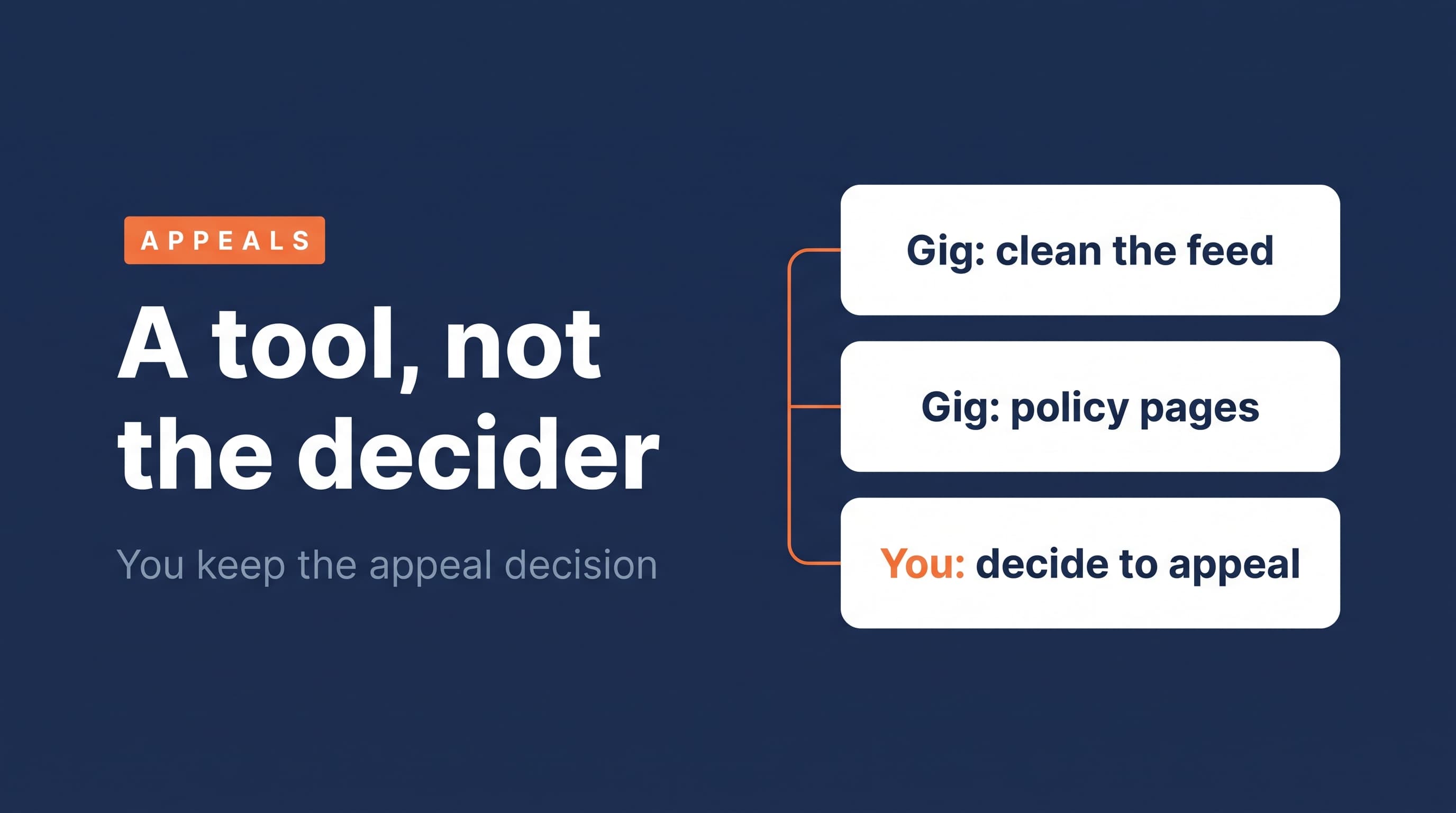
That can be fine. A gig is a good tool for scoped technical work: cleaning up a feed, correcting product data, rewriting policy pages, or checking a site against a list you made. You know what needs doing, and someone else does it faster or cheaper than you would.
It goes wrong when the gig becomes the decision maker. Skip anything sold as "guaranteed reinstatement", and any appeal written without a full audit first. Even careful sellers say it themselves: nobody can guarantee Google's final decision. The seller does not know your business, so you supply the facts and documents, you check the result, and you decide when to appeal. A gig is a tool. It is never the one who decides.
Route 3: a reinstatement service
Done-for-you services sit at about $600 to $2,500. The better ones do real work for that money: an audit of your site, Merchant Center and feed, the fixes, the appeal and a few weeks of follow-up. If the provider actually fixes the cause, this route can work.
Look closely at the word "guarantee". In the sample I checked, it almost always means money back if you are not reinstated within 30 to 60 days, or a fixed refund. That is a refund promise, not a reinstatement promise. The clearest provider says so outright: it guarantees "the process, not the outcome". The only true no-cure-no-pay offer I found cost about A$6,500 to 9,000, and only for cases the provider had screened in advance.
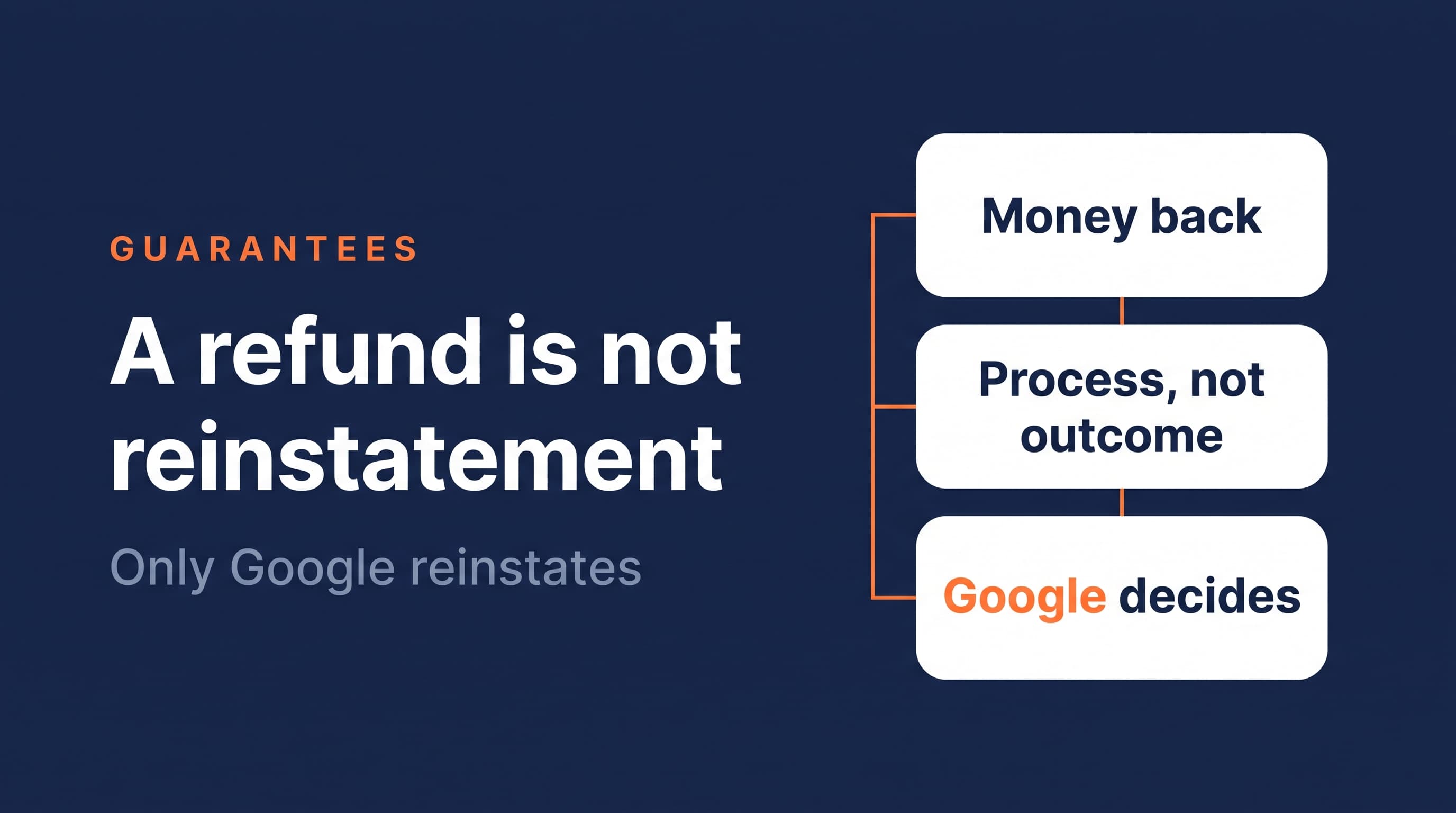
That is not dishonest. It is the only promise anyone outside Google can make, because accounts "are only reinstated in compelling circumstances" and Google decides what counts as compelling.
Before you pay, ask three questions:
- What exactly will you change in my feed, in Merchant Center and on my site?
- Who decides when the review request goes in, and who submits it?
- What happens to my money and my review attempts if the first review fails?
If the answers are mostly about the appeal letter, you are buying a text and an attempt. If they are about the causes, you are buying a fix.
Route 4: fix the cause across the chain
Misrepresentation is rarely one broken page. Google says it "may review information from multiple sources including your listing, website, accounts, and third-party sources" (Google Help). For a store, those sources form a chain: the product data in your shop, the feed built from it, your Merchant Center settings, the product page, the store-wide trust pages (contact, shipping, returns), the checkout, and your identity and business details.
In my experience, the cause usually sits where two links disagree. A price in the feed that the checkout does not honor. A return window in Merchant Center that your returns page contradicts. An address on the site that differs from the one in the account. Each page can look fine on its own. The problem only shows when you put them side by side, and that is what Google does.
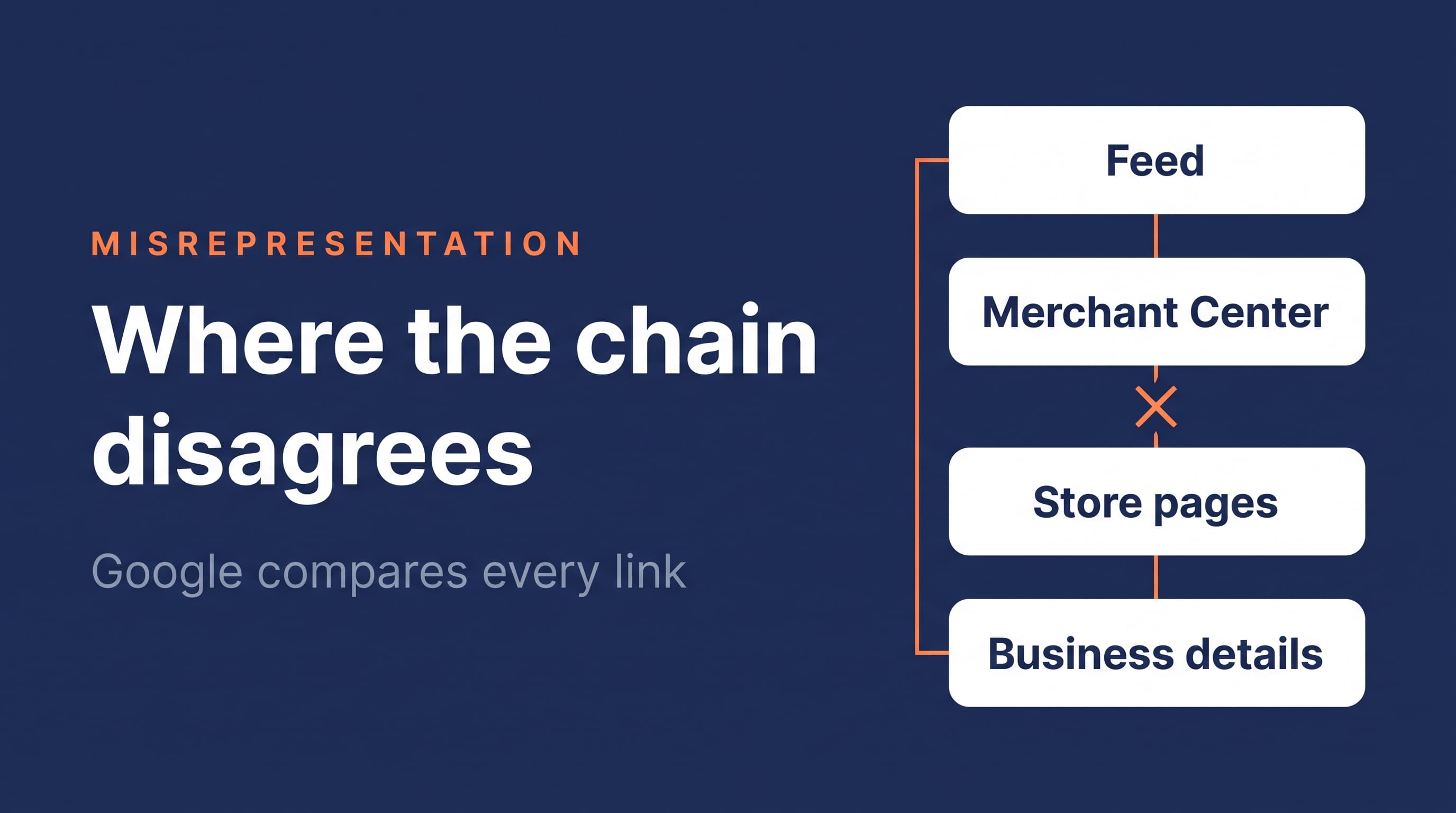
So this route starts with the whole chain, in that order: feed, Merchant Center, product page, trust pages, checkout, identity and business details. I look for the inconsistency Google sees, correct it so you can show what changed, and only then build a review request that explains exactly that. You decide when it goes in.
What I fix myself is the part the Shopping Fix covers: feed, product data and Merchant Center. Site, checkout and identity issues get decided case by case. Either you get a precise change list that you or your developer carry out, or I do the work as a separately paid job. That choice is written into the scope before we start, so you know what I do, what you do and what is not guaranteed. I guarantee what I control. On day 1 we agree a list of the feed issues I fix. On day 30 each one is fixed, or excluded with your OK, and anything still open I follow up for free for up to 30 more days. Whether Google reinstates your account is Google's decision, and nobody can promise you that.
This route fits when the store is legitimate but the problem is spread over several links. Especially with hundreds or thousands of products, weeks offline, a review that already failed, or no time or technical knowledge to audit it all systematically. One clear fault? Go back to route 1. A business practice that is the problem? Then I say no, for the reason above.
Which route fits your situation
| Your situation | The route I would choose |
|---|---|
| Legitimate store, one clear fault (address, return terms, a price mismatch), a few hours to spare | Fix it yourself, then one careful review |
| You know exactly which task needs doing but not how, or you lack the time | A gig for that one task. You keep the decision to appeal |
| You want it done for you, and the provider can say exactly what they will change | A reinstatement service, after the three questions above |
| The problem is spread over feed, Merchant Center and site, with many products, weeks offline or a failed review behind you | Fix the cause across the chain |
| Google put you in a no-warning category by mistake | One careful appeal, with proof of how your business really works |
| The problem is the business practice itself: a fake address, hidden fulfillment, counterfeit goods, hidden costs | No route helps. Change how the business works first |
What to do today
Fix the cause first, decide on the appeal yourself, and never pay for a guarantee Google doesn't give.
You do not need to buy anything to start. Open the issue in Merchant Center, write down the policy Google names, and put your feed, your Merchant Center settings and your store pages side by side. Find one clear fault? Fix it and request one review.
Can't find where the chain breaks? Send me your feed through the free Feed Review. Within 3 business days you get the biggest fixes, and an honest answer on which of these four routes fits your store, including when the answer is "do it yourself".
Frequently asked questions
Is a Merchant Center suspension permanent?
Not always. For most misrepresentation issues you can fix the cause and request a review. For unacceptable business practices, coordinated deceptive practices and dishonest pricing, Google says accounts are suspended "upon detection and without prior warning" and that you will not be allowed to list content with Google again, unless an appeal shows it was an error. Google also says there may be a limit on how many reviews you can request, so treat every attempt as precious.
How do I fix a Google Merchant Center suspension?
Read the exact issue and policy in Merchant Center first. Then audit the chain: feed, Merchant Center settings, product pages, trust pages, checkout and business details, and correct whatever disagrees. Finish identity verification if Google asks for it, and only then request one careful review that explains what you changed.
Can Google Merchant Center support lift my suspension?
The way back is a review request after you have fixed the cause. Support cannot shortcut that: Google says support "can't bypass or shorten the cool down period" that may follow an unsuccessful review. Use support to understand the issue, not to reverse it.
How long does a Merchant Center review take?
Google's guidance after you submit is to "wait 7 business days", and you get an email when the review is done. Your ads may not show while the account is under review, so plan for that week and do not send a second request while the first is open.
Should I pay someone to get my Merchant Center account reinstated?
You can pay someone to do work, but nobody can sell you reinstatement, because Google decides. Pay for a clearly scoped task or for fixing the cause, and be careful with anything sold as guaranteed reinstatement. In October 2026 I found prices from about $10 for a gig to $2,500 for a done-for-you service, and every "guarantee" I saw was a refund promise, not a reinstatement promise.
About the author

Auke Jongbloed
Auke Jongbloed is a Google Shopping and product feed specialist. He builds a product feed manager for WooCommerce, and works directly with ecommerce store owners on Google Shopping and Performance Max setups via aukemarketing.com. Follow him on LinkedIn for more on Google Shopping and feed strategy.
Free feed review
Get the 5 biggest fixes for your Shopping feed
Send me your store and I look at your product feed and Merchant Center. Within 3 business days you get the 5 biggest fixes, in plain language. Free, 5 reviews per month, no commitment.
Get your free feed review